The podcast that i created was focused on the topic ” “what benefits and limitations are involved in using digital media to facilitate student learning and engagement?” I chose this topic because i felt that i could personally relate to it. In terms of strategy, i thought that before anything, a script would need to be made. In doing so i sourced scholarly sources to use in the podcast and aside from that i decided to throw in my own personal experience. I did this just to make it easier for listeners to relate to, as apposed to taking the points from a scholarly source and really delving into that. After making the script, I then needed to find a platform to record on. This needed a little researching online and I came across a platform called Podbean. This allowed me to record, add music and special effects all from an app. I connected my Airpods to my phone to help with microphone quality.
In terms of my reading, i gained two valid points that i wasn’t necessarily thinking of before. This in turn, helped me to bring the discussion to a different level and talking about the points i garnered by doing research/reading. When using my sources in the actual podcast, I simply just mentioned the author or author’s names and then followed up by reading out the point that they had made in their writings. After this I tried to go through their points and what my take on it all was.
None of my own actual content was used during the making of this podcast. The intro and outro music that can be heard was used from the particular platform that i used. They were samples that the platform has stated are free and for public use. If you pay to subscribe to their platinum membership, you can have access to more samples and effects.
The biggest challenge I had was converting the podcast that had been recorded on my phone, to an acceptable format and uploading it on soundcloud on my laptop. Luckily i realized that when i saved the podcast on the Podbean app on my phone, it was actually saved on their online server. This meant that i could go onto their website and once i had logged in, i could access the very same podcast that i had recorded on my phone. Once this was done i just had to save the file and upload it to soudcloud. The other biggest challenge was to not sound nervous. In this instance it was the case of ‘fake it until you make it’. I have seen and heard many podcasts before and reprogramming my mind in a way so that I believed i had done this many times before (even though i hadn’t) was the biggest help in ensuring my tone, voice and confidence was where they all needed to be.
Online identity is a concept that has become more and more important as each year goes by. In this day and age, we are spoiled for choice when choosing what particular platform we choose to establish our identity. Furthermore, it is possible to have different identities for different platforms. Instagram, which has become one of the most popular social media platforms in the world, is one where an individual’s identity can become quickly misconstrued. Instagram’s focal point is its ability to allow users to post pictures with captions, to an individual’s following. As Instagram’s focus is on pictures that are taken by users, it becomes easy to construct a false image and identity of oneself. But where does this need to create a false persona actually come from? It is possible that we ourselves are only partially to blame, and that social media in the true instigator. Because of Instagram, we are directly exposed to millions and millions of attractive, famous and wealthy individuals with a few just clicks of a screen. It gives us a glimpse of what their lives are like, what they do on a day-to-day basis. Perhaps the biggest problem of having this type of access and exposure is that we start to model our identities after these people, and start to force their personas upon ourselves. Identity, therefore, appears as a result of the balance between the pressures of the unconscious and those of the external world (Faccioli, 2019). Before social media, we did not have this direct line of access to these people. The only ways we could get a glimpse of these celebrities, was through mainstream media, magazines and interviews.
One major problem with all of this is that due to Instagram’s nature, it is so easy to present an image to one’s following, that it may not even represent us at all.
My life is not how it appears…
Photographs taken by Jordan Henderson
These images come directly from my own Instagram page. By looking at them, it is easy to create a persona that involves being an ‘outdoors’ type of person who loves hikes, waterfalls and physical activity. This however, is really not a true indication of my life at all. It is a perfect example of how i aim to hide the life i actually live day to day, and replace it with how i actually want people to see me. By looking at these selected photos, it is almost impossible to know that i am a full time student and work a 9-5 desk job.
But why?
Obviously this begs the question… why would I or anyone else do this? I believe that the answer is validation. All we ever see on Instagram are famous people living glamorous lives and it makes us want to do the same. It makes us want to be validated by our friends, family, peers etc. The problem with this, is that our REAL lives, the lives we live Monday to Sunday are sometimes far from glamorous and will almost never be validated by those who week seek validation from, or so we think. This leads into what is likely an even bigger issue. We are now seeking validation from people we do not know and quite frankly we do not particularly care about. This is truly dangerous.
Consequences..
Leaving your persona and hope for validation purely in an online format can perhaps be viewed as ‘safe’. Bringing your online persona and forcing it onto your physical existence is perhaps asking for trouble. If one’s lust for validation leads to them purchasing an expensive outfit they don’t really like, a car they cannot afford or a house that is above their budget, we then venture into dangerous territory. Depending on the extent one takes it to, it can truly affect the life we actually live and those we actually care about. Something that is common is individuals financing cars they should not even be looking at. Ultimately putting them under financial pressure only because they wanted a few pictures and the image that they are ‘rich’ or ‘doing well’. And when you add very REAL aspects of life such as partners and children to the mix we have a recipe for disaster. Controlling our online persona and how far we take is is paramount.
Different personas for different platforms
As mentioned earlier, it is possible to have different personas for different platforms. How one sets up their Instagram account may be very different from how their Twitter or especially Linkdin accounts are made. For myself, Instagram is for displaying how I wish people to view me. Twitter is more of a free space where i can talk about whatever i want and put my thoughts out into the world.
This other tweet relates the the changes in Australia’s Budget that have been made recently.
Twitter for me is a free fall all, a creative space where i can post my thoughts and feelings about a range of topics.
Screenshot By Jordan Henderson.
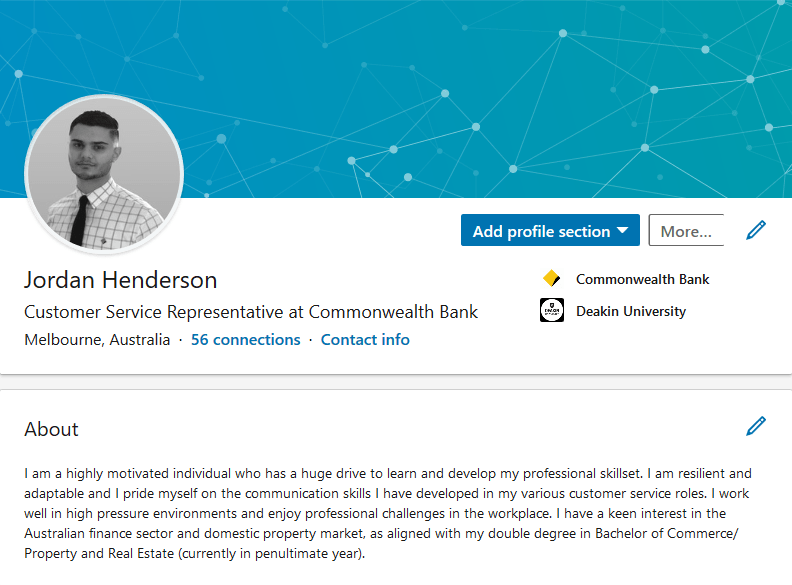
For obvious reasons, my Linkdin profile is immensely different from my Instagram and twitter pages. This page displays my professional side and is mostly used for interacting with colleagues and other professionals.
The crazy thing is, is that there are three different profiles above, all very, very different. Which one is real? Maybe none of them are. Or, maybe all of them are. I believe that how we depict our online identities, is a result of how we view our one true identity, and how we wish to display them on the various online platforms available. What is truly amazing, is that every individual views all of these things differently, leading to various interpretations of social media and our identity.


 thewolfofallstreets